
Detergent Industry — Soda Ash, SLES, Sodium Sulfate & Sodium Bicarbonate Solutions
The detergent industry manufactures a wide range of cleaning products, including laundry powders, dishwashing liquids, industrial cleaners, and other household and institutional detergents. Key chemicals in this sector improve cleaning performance, control water hardness, enhance solubility, and stabilize formulation properties. YRC supplies soda ash, sodium bicarbonate, SLES, and anhydrous sodium sulfate for detergent applications. These materials support washing efficiency, foaming performance, pH adjustment, and cost-effective production.
RELATED PRODUCTS
Sodium Lauryl Ether Sulfate (SLES70%)
SLES is an anionic surfactant with strong cleaning properties, good foaming ability, and mildness. It is readily soluble in water and suitable for laundry, dishwashing, and industrial cleaning formulations.
SLES acts as a core cleaning ingredient. It emulsifies oils, disperses stains, and works with enzymes to improve stubborn-stain removal. Its moderate foaming suits both machine and hand washing, and it is less irritating than traditional surfactants, making it suitable for close-fitting garments.
Related Value
In mid-to-high-end laundry detergents, SLES supports the “low irritation + efficient stain removal” selling point and meets household demand for gentle cleaning.
Product Function
SLES quickly penetrates oil layers and breaks oils into water-soluble particles that rinse away easily. Its low-residue characteristics support food-contact-safe rinsing.
Related Value
It improves oil removal efficiency in dishwashing detergents, reduces the number of washes, and suits bulk cleaning in home kitchens and catering operations.
Product function
At higher concentrations, SLES can peel off heavy oil stains. When combined with alkaline additives such as soda ash, it enhances cleaning power and offers good resistance to hard water in complex industrial water conditions.
Related Value
It supports heavy-duty industrial cleaning formulations, reduces reliance on additional surfactants, and maintains performance in hard-water conditions.
Soda Ash Light
Soda Ash Light provides strong alkalinity, adjusts pH, softens water, and participates in chemical reactions in detergent formulations.
As a key alkaline additive in laundry detergents, Soda Ash Light is combined with surfactants such as SLES to improve cleaning efficiency and stain removal.
Product Function
Soda Ash Light softens hard water and enhances surfactant activity. It also adjusts the wash solution to alkaline pH, improving emulsification of oil stains.
Related Value
It enables cost-effective detergent formulations, works synergistically with SLES, and meets mass-market demand for affordable performance.
Application Scenarios
Used as a fruit and vegetable cleaning agent to remove surface pesticide residues, particularly organophosphate pesticides.
Product Function & Value
Sodium bicarbonate uses its mild alkalinity to hydrolyze and break down persistent pesticide molecules on produce. This mechanism is effective yet gentle, providing a non-irritating clean with no harmful residues, making it suitable for pretreatment of fruits and vegetables in household kitchens.
Sodium Bicarbonate
Sodium bicarbonate is weakly alkaline, mild, non-corrosive, and decomposes easily into carbon dioxide when heated.
Applied in mid-to-low-end powdered laundry detergents primarily to modify and standardize product density and improve powder flowability.
Product Function & Value
As a cost-effective filler in powdered laundry detergents, anhydrous sodium sulfate helps create uniform particle size and consistency. This uniformity makes the product easier to package, transport, and pour, while remaining compatible with and non-disruptive to the cleaning power of active surfactants.
Application Scenarios
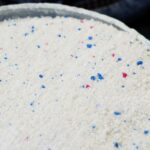
Used in white or blue detergent powders to create visual impact and reinforce brand recognition. Different colors can support different product positioning, such as stain removal, color care, or freshness.
Product Function & Value
Colored speckles are free-flowing, controlled in particle size, and tested for bulk density, pH, moisture, and dissolution time to ensure uniform blending and batch-to-batch consistency.
Colored Speckles
Colored speckles are added to detergent powder at controlled ratios to create visual contrast and support product differentiation on shelf.
How does the quality (e.g., purity, chain length) of SLES affect my final detergent product?
The quality of SLES is critical. Higher purity ensures better performance, reduced odor, and longer shelf life. The ethoxylation degree (number of EO units) impacts viscosity, foam stability, and solubility. We offer various grades to help you achieve the desired viscosity, clarity, and cleaning performance in your specific formulation.
What is the main difference between Soda Ash and Sodium Bicarbonate in detergent applications?
The key difference is alkalinity. Soda Ash (Na₂CO₃) is a stronger alkali (base) and is primarily used as a builder to soften water, inactivate hard water ions, and maintain an optimal pH for soil removal. Sodium Bicarbonate (NaHCO₃) is a milder alkali and abrasive, often used in gentle cleaning powders, as a pH buffer, and for its deodorizing properties.
Does Sodium Sulfate have any actual cleaning power, or is it just a filler?
While its primary role is as a processing and bulking agent, it does provide a minor secondary cleaning benefit. As an electrolyte, it can help reduce the critical micelle concentration (CMC) of surfactants, allowing them to form micelles more easily and improve overall efficiency.
How do I determine the right grade and concentration for my specific detergent formulation?
Our technical support team is ready to assist you. The optimal grade depends on your product type (liquid vs. powder, heavy-duty vs. delicate), desired pH, and manufacturing process. Contact us with your formulation goals, and we will recommend the best products for your application.
Have a specific technical question? Contact our experts today for a consultation.
Contact us to learn more
The form has been submitted successfully!
There has been some error while submitting the form. Please verify all form fields again.